OCA/DCA BVR Tactics

F-16C OCA/DCA BVR Tactics 2.0

Please login to download

v303FG Public BVR Gameplans & Execution Guide​


0) Quick Glossary (commit-level must-knows)​

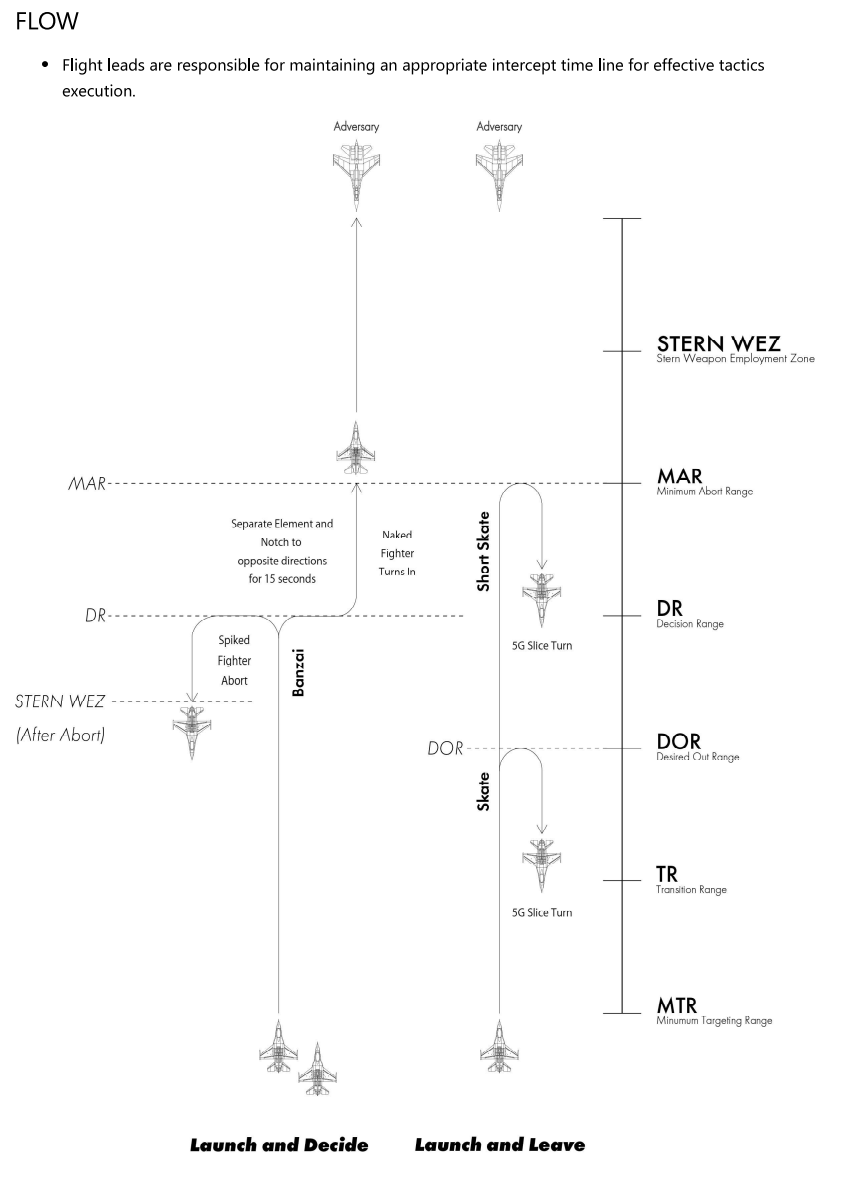
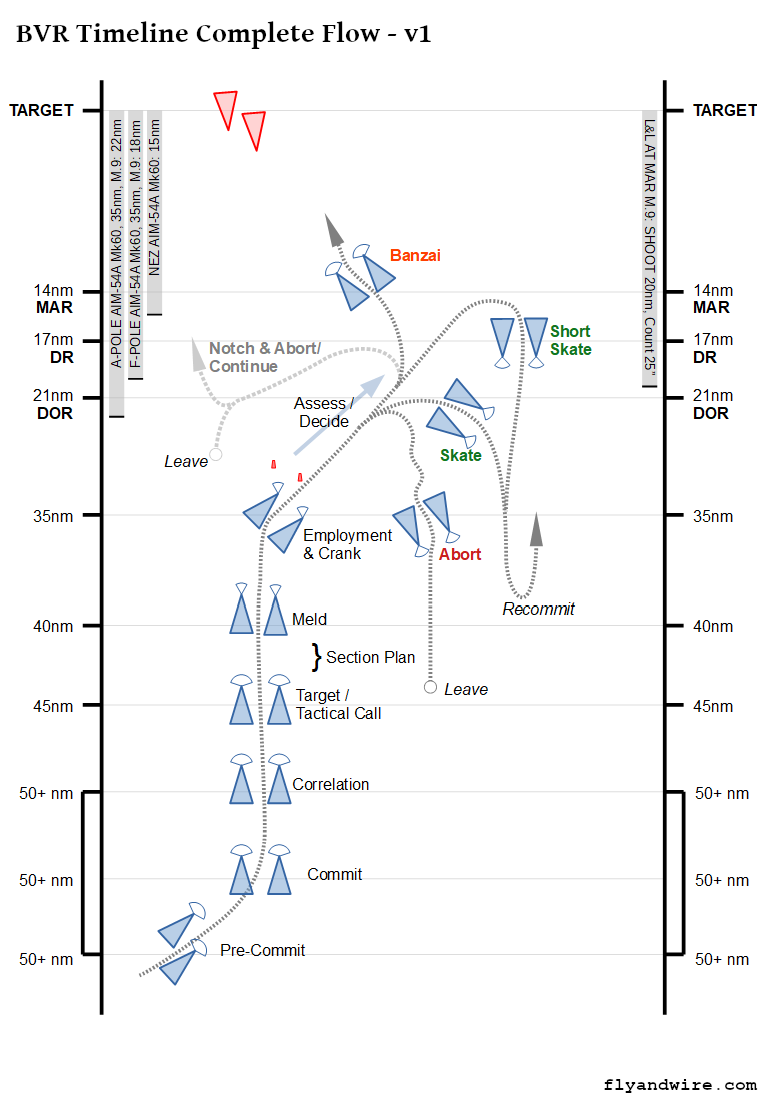
  • TR (Transition Range): Min range you can Fox-3 and be HUSKY before DOR.
  • DOR (Desired Out Range): Range where your abort/pump will kinematically defeat anything in the air and give you space/time to recommit with L&D tactics.
  • DR (Decision Range): Range where you can execute the briefed notch for ~15 s, evaluate spikes, and still defeat shots / stay outside STERN WEZ.
  • MAR (Minimum Abort Range): Closest you can be and still defeat the adversary’s FLO shot with a standard abort.
  • MRR (Minimum Recommit Range): The minimum range you can turn hot again, target, and shoot while remaining outside STERN WEZ.
  • STERN WEZ: Range at which the bandit can still kill you with a rear-aspect shot as you run away.
  • Pump / Abort: Turn cold (120–160°) and run.
  • Pitchback: Reverse from cold to hot when criteria are met (often at/after MRR).
  • Crank: Turn ~40–60° off to reduce closure while supporting your missile to HUSKY.

Rule of Thumb (start point – refine with squadron testing):
  • High fast (35–40k ft, M1.2) AIM-120C vs hot Flanker: TR 18–22 nm, DOR 16–18 nm, DR 12–14 nm, MAR 10–12 nm.
  • Medium (25–30k ft, M0.9): TR 15–18 nm, DOR 14–16 nm, DR 10–12 nm, MAR 8–10 nm.
  • Low (15–20k ft, M0.9): subtract ~2–3 nm from each.

These are starting points. You must build/review v303FG range cards from test shots to tighten these.


1) What is a "Gameplan"?​


A pre-briefed, if/then decision tree that:
  1. Aligns the whole package on commit/abort logic,
  2. Dictates shot timing (Skate/Short Skate/Banzai),
  3. Controls the flow between elements (Wall/Grind), and
  4. Defines cold ops and recommit behavior (stagger back, notch back, delouse).

You brief a gameplan so no one is guessing at 1.2 nm inside MAR with 4 nails in their RWR.


2) Core BVR Timelines (How to compute/brief them)​


2.1 Build your card (per altitude / speed / loadout​

  • Record shots in DCS (SP/MP test range) at known altitudes, speeds, and bandit speeds/aspect.
  • Capture A-pole (HUSKY), F-pole, time to active, and kill/no-kill.
  • From those, derive:
    • TR: Missile must be active before you hit DOR.
    • DOR: "If I pump here, no missile can hit me and I can reset."
    • DR: "If I notch here for 15 sec, check spikes, I can still survive + exit STERN WEZ."
    • MAR: "If I’m any closer and they shoot FLO, I die unless I’m very lucky."

2.2 Kinematic sanity checks​

  • Your exit speed matters. Plan to unload (1–2 G), MIL/AB on abort to maximize extension.
  • Bandit closure: Fast HOT bandits shrink DOR/DR/MAR margins. Use AWACS speed calls or datalink to adapt.
  • Altitude: Lower = worse missile kinematics. Expect to reduce all ranges 2–4 nm.


3) Pre-Commit Setup (DCS F-16C specifics)​

Formation / Geometry
  • Wall (2x2): Elements line abreast, 7–10 nm element spacing, 1.5–3 nm within element. Best for wide picture and early sort.
  • Grind: Elements in trail (30–50 nm). One hot, one cold, pumping on a schedule/range.

Sensors
  • FCR:
    • 80 nm scale outside 40 nm; step to 40 nm at/inside MTR.
    • 4B/60° (lead), 2B/30° (wing) OR lead in TWS, wing in RWS/TWS narrow as directed.
  • Link 16 (HSD/SA): Confirm donor tracks, group labels, and targeting deconfliction.
  • RWR: Pre-briefed rings for MAR/DR (mental overlay). Prioritize STT nails and threat emitters.

Weapons
  • AIM-120C (F-16C):
    • SMS > A-A > 120C, RAID OFF, PRI.
    • TMS UP to bug, TMS RIGHT to cycle track files in TWS, TMS UP for L&S.
  • JHMCS: Use for MRM SA and quick TMS actions.

Comms
  • BRAA/Bullseye: based on SOP (we use bull most often).
  • Targeting / Sorting: Short and standard (examples below).
  • Gameplan commits: "Viper1, Wall Skate. #1,2 East; #3,4 West. TR 18, DOR 16, MAR 10. DR 12. 15-sec notch. Pump south."


4) The Big Three Gameplans​


4.1 SkateLaunch & Leave

Intent: Preserve weapons and energy, defeat FLO shots, reset to fight again.
You: Fox-3 before TR, crank/pump before DOR.
They: Forced defensive / drag, or your missile kills.


Step-by-step (example numbers):
  1. Commit: "Viper1, commit East Group, Wall Skate."
  2. Targeting: "#1,2 East Group; #1 sorted lead, #2 sorted trailer."
  3. Fox: At TR (18 nm), Fox-3. "Viper11, Fox-3 East Lead, 18."
  4. Crank: 40–60° off to manage closure until HUSKY.
  5. Pump: At DOR (16 nm) call "Viper1 pump south." Turn cold, unload, accelerate.
  6. Assess: If naked/no spike, support your missile (if still time). If spiked/STT, keep pumping to MRR.
  7. Recommit: At/after MRR, other element should already be hot (Grind) or you turn hot if Wall and deconflicted.

Comms template:
  • "Viper1, Wall Skate, TR 18, DOR 16, MAR 10, DR 12, 15-sec notch, pump south."
  • "#1,2 East; #3,4 West. #2,4 sort trailers."
  • "11 Fox-3 East Lead 18, cranking right."
  • "Viper1 pump south, cold."
  • "Viper3 hot, commit East Group, Fox-3 20."

4.2 Short SkateEarlier leave to kill FLO


Intent: Abort before MAR, even earlier than Skate, maximizing survivability against an early adversary FLO shot.


Key difference: Your abort happens at/just before MAR/DR, not at DOR.


Use when:
  • You’re energy/altitude disadvantaged
  • Expect high-Mach, long-range FLO from red air (e.g., R-77-1/SD-10 threats)

4.3 BanzaiLaunch & Decide


Intent: Commit to the merge if you’re clean/naked post-notch; abort if not. Greater chance to kill/press but higher risk.


Step-by-step:
  1. Commit: "Viper1, Banzai East Group."
  2. Fox-3: Before DR (e.g., 13 nm). "11 Fox-3 East Lead 14."
  3. Bracket / Notch: Elements split to bracket headings (e.g., 090/270), notch for 15 seconds.
  4. Spike Check: If spiked, abort (pump). If naked, turn hot, accelerate, press to follow-on shot or merge.
  5. Reform: If aborting, call cold heading and reset to MRR for recommit.

When to choose Banzai:

  • You must deny area/kill group rapidly for STRIKER/DTI reasons.
  • You have numbers/altitude/energy advantage.
  • You’re willing to trade higher risk for quick control of the airspace.


5) Formations & Flows: Wall vs Grind


5.1 Wall (2x2 wide front)​

  • Pros: Best for fast group ID/sort/targeting. Can combine with Skate/Short Skate/Banzai.
  • Cons: Requires timely pump calls to avoid all 4 inside MAR simultaneously.

Execution tips:

  • Element spacing: 7–10 nm. Assign East/West (or North/South) group responsibilities.
  • Deconfliction: Lead element pumps at DOR, trail element covers.

5.2 Grind (hot/cold cycling)​

  • Pros: Keeps a fighter always hot while the other extends, great for persistent DCA.
  • Cons: Needs strict pump ranges + element discipline.

Execution flow:
  1. Element 1 hot, Element 2 cold.
  2. Element 1 pumps at DOR → Element 2 pitchbacks to hot.
  3. Repeat.

Pump criteria: Pre-brief pump ranges (e.g., DOR 16 nm) and pitchback criteria (e.g., element cold to 40 nm or once MRR satisfied).


6) Cold Ops Gameplans​


6.1 Stagger Back (2-ship)

  • Spiked fighter runs cold until pitchback criteria; the untargeted fighter turns hot and shoots.

6.2 Notch Back (2-ship)

  • Spiked fighter executes a notch, then, once notch timer expires, assesses pitchback criteria and recommits if safe.

6.3 Delouse (4-ship)

  • Leaned-on element runs. The other element recommits and targets to clear the bandit press.

Cold Ops Golden Rule: No one stays cold forever. Build hard pitchback criteria (time, range, fuel, SA) so the formation doesn’t collapse.


7) Targeting, Sorting, and Labeling​


7.1 Targeting​

  • Group (≤3 nm spacing) → assign to elements: "#1,2 East Group; #3,4 West Group"
  • Once targeted, call: "Viper12 Targeted East Group"

7.2 Sorting​

Inside the group, split Lead/Trailer (or Near/Far, High/Low).
  • Call: "Viper12 Sorted Trailer East Group"

7.3 Picture Labels (standardize)​

  • 2-Group Wall: North/South or East/West
  • Azimuth: Wide/Close
  • Range: 10/20/40 nm groups

Example: "2-Group, East/West, 10 wide, East group 2 contacts, 32k/28k, fast; West group 1 contact low 15k, hot"


8) Lead / Wing Responsibilities (per timeline)​


Lead:
  • Build & brief gameplan, pump/pitchback criteria, deconfliction
  • Assign targeting/sorting
  • Execute commit/abort calls
  • Maintain big-picture SA (AWACS, Link, offboard sensors)

Wingman:
  1. Stay visual (inside element)
  2. Maintain formation geometry (line abreast / bracket)
  3. Execute directed radar work (not freelancing)
  4. Call "Blind" immediately when visual lost (and provide bull & altitude)


9) Practical DCS Numbers & Techniques​

9.1 A-pole / F-pole discipline​

  • For Skate: You want A-pole before DOR. Don’t support too long—pump on time.
  • Crank philosophy: Crank until A-pole, then pump.

9.2 Notch timing (Banzai/DR)​

  • 15 seconds is the standard check. If after 15s you’re naked, turn hot. If still spiked (especially STT), abort.

9.3 Pump geometry​

  • 120–160° turn away from bandit. Choose a common cold heading in the brief (e.g., south to the tanker/SA area).
  • Unload to 1–2 G, AB to extend faster and open DOR → MRR spacing.


10) Example: Full 4-Ship Flow (Wall + Skate)​


Briefed:
  • TR 18, DOR 16, DR 12, MAR 10, 15-sec notch
  • Wall, #1,2 East; #3,4 West
  • Cold heading: 180
  • Grind fallback if 2+ groups detected

Execution:
  1. Commit (40 nm): "Viper1, commit 2-group East/West, Wall Skate."
  2. Target (30 nm): "#1,2 East group; #1 lead, #2 trailer. #3,4 West group; #3 lead, #4 trailer."
  3. Fox (18 nm): "11 Fox-3 East Lead 18, cranking right." "12 Fox-3 East Trailer 17."
  4. Pump (16 nm): "Viper1 pump south, cold." Element 2 (3/4) goes hot now.
  5. Element 2 Fox (20 nm): "13 Fox-3 West Lead 20."
  6. Recommit at MRR (~30–35 nm separation): Element 1 pitchbacks hot, swaps in.
  7. Cycle continues until groups are sanitized or we hit BINGO/merge rules.


11) BVR Comms Templates​


Commit:
"Viper1, commit [group count/label], [Wall/Grind] [Skate/Short Skate/Banzai]. TR xx, DOR xx, DR xx, MAR xx, [cold heading]."

Targeting / Sorting:
"#1,2 East Group, #1 lead #2 trailer. #3,4 West Group, #3 high #4 low."

Fox:
"11 Fox-3 East Lead [range], cranking [left/right]."

Pump:
"Viper1 pump [cardinal], cold."


Spiked / Naked call:
"11 spiked 29 STT, pump south."
"12 naked, turning hot."


Recommit / Pitchback:
"Viper1 hot." / "Viper1 pitchback now." / "Viper3 hot, Viper1 cold."

Blind/Visual:
"12 Blind 28k, Bulls 045/32."
"12 Visual."


12) Training & Debrief Checklist​


In-mission:
  • Did we shoot at TR and leave at DOR/MAR?
  • Did element timing prevent all 4 from being inside MAR simultaneously?
  • Did we respect notch timers and spike/naked logic?

Tacview / ACMI review:

  • Time from Fox to A-pole, F-pole
  • Pump ranges vs pre-briefed DOR/MAR
  • DR notch start/end, spike/naked status, survival
  • Recommit spacing (did we meet MRR?)
  • Communication clarity (missed, late, over-transmitted)

Update the Card:
  • Adjust TR/DOR/DR/MAR/MRR for the altitude/speed actually flown
  • Record bandit types, speeds, ECM use, altitude


13) Common Errors & Fixes​


ErrorWhy it kills youFix
Late pump (inside MAR)You eat the FLO shotHard brief DOR/MAR + auto-callouts on HSD rings + wingman policing
Both elements coldYou cede airspace, STRIKERS dieUse Grind or explicit hot/cold handoffs
Wingmen radar freelancingLost sort, double-target / unserviced groupLead gives explicit radar roles, wing confirms
No notch timer disciplineYou die in Banzai or overcommitUse 15s standard, lead enforces
No numerical timeline in briefNobody knows when to shoot/leaveAlways brief TR/DOR/DR/MAR/MRR numbers


Final Notes​

  • Gameplans are discipline. You win BVR in the brief + timeline adherence.
  • If you’re not sure (fuel, spike, SA): Skate. Live to recommit.
  • Banzai is a tool—don’t make it your default just because it’s exciting.
  • Codify your numbers, update often, and make them muscle memory with comm brevity.


1678391165494.png


1692198352738.png
  • 1676051506254.png
    1676051506254.png
    52.3 KB · Views: 1,450
  • 1676051722177.png
    1676051722177.png
    21.7 KB · Views: 1,380
Author
Wing
Downloads
84
Views
5,491
Visitors
71
First release
Last update
Rating
0.00 star(s) 0 ratings
Top